Spectrum Sharing between Earth Exploration Satellite and Commercial Services: An Economic Feasibility Analysis

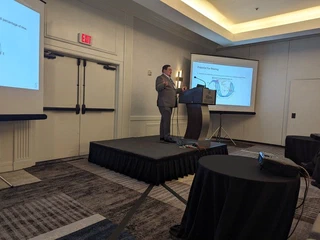 Presenting the paper during the plenary session. Image credit: Prof. David Starobinski
Abstract
Microwave radiometers operating on Earth-observing satellites provide critical support for weather forecasting as well as oceanographic, atmospheric, and geophysical monitoring. Maintaining spectrum access is vital for continued support of these observations which are easily corrupted by any anthropogenic transmissions occurring within the time-frequency space utilized by the radiometers. Despite these requirements, spectrum sharing is also well motivated to accommodate the ongoing expansion of high band 5G systems, given the relative sparsity in time of radiometer spectrum access at a specific location. In this paper, we propose a joint queuing and game-theoretic model to evaluate the conditions under which commercial users have incentive to utilize shared spectrum in the face of preemptions by Earth Exploration Satellite Service (EESS) users. The model is justified using real traces of EESS Spectrum access, which are made publicly available to the research community. We assume commercial users are served by a provider charging a pay-as-you-go admission fee. We determine that in such a scenario, the resulting Nash Equilibrium is unique. However, increasing the fraction of commercial users opting to utilize available spectrum lowers the incentive for newly arriving users to follow suit, impacting provider profits from admission fees. Furthermore, we show that the socially optimal state is attained with the profit-maximizing fee. These results demonstrate the potential for temporal sharing between space-based Earth observing microwave radiometers and commercial users in a manner providing societal benefits.
Type
Publication
2024 IEEE International Symposium on Dynamic Spectrum Access Networks (DySPAN)

Authors
Jonathan Chamberlain
(he/him)
Unaffiliated Researcher
As a Graduate Research Fellow with BU NISLAB, I published a number of papers, including a paper in collaboration with the Ohio State ElectroScience Laboratory stablishing the economic feasibility of sharing for wholesale commercial markets yielding priority to mission critical Earth Exploration Satellite Service-passive (EESS-passive) radiometers which received the Runner-Up accolade for Best Paper on the Policy Track at IEEE DySpan 2024. I was also actively involved in multiple service roles, including serving on the executive board of the Boston University Student Association of Graduate Engineers in various roles, membering on an advisory committee providing feedback for university initiatives and proposed policy updates to the Associate Provost for Graduate Affairs, and co-organized the 10th and 11th editions of the BU Center for Information and Systems Engineering Graduate Student Workshops in 2024 and 2025. For these efforts, as well as my work mentoring students both within the NISLAB and in other projects as well as my published research, I was recognized with the BU ECE Department Doctoral Acheivement Award for the 2024-25 academic year. I additionally had the privilege of participating in the 2025 NSF NeTS Early Career Investigators workshop.