Advancing Spectrum Sharing through Statistical Analysis of EESS-Passive Satellite Overpasses
2025-05-13· ,
,
Nicholas Brendle
Equal contribution
Jonathan Chamberlain
Equal contribution
,Joel T. Johnson
David Starobinski
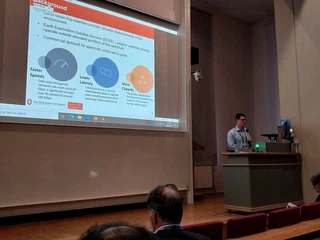 Paper lead author N. Brendle presenting paper during 2025 DySpan plenary session. Image credit: Jonathan Chamberlain.
Abstract
Earth-observing measurements performed by Earth Exploration-Satellite Service (EESS) passive satellites are critical to meteorological and climatological assessments of the state of planetary conditions. Radiometers, which perform these measurements, are highly sensitive to anthropogenic transmissions. Therefore, other user access to the spectrum must be carefully managed during an overpass. In this work, we present a statistical characterization of interarrival times and durations of EESS-passive satellite overpasses to support studies between active and passive users co-existing within the radio spectrum. Our work analyzes datasets compiled from multiple EESS-passive satellites to determine the frequency and duration of service interruptions to support the design and evaluation of spectrum sharing approaches. EESS-passive satellite observations that fall within a 100~km region surrounding 15 selected cities are used to produce complementary cumulative density functions (CCDFs) for interarrival times and durations. While the CCDFs for the interruption durations appear location-independent, the interarrival CCDFs demonstrate a high correlation with city latitude due to the nature of EESS-passive orbits. The interarrival time mean and standard deviation are found to be similar and are characterized with simple quadratic functions of latitude that achieve R-squared values of 0.993 and 0.996. The similarity of the mean and standard deviation suggests that a Poisson arrival process (having exponentially distributed interarrival times) is a reasonable assumption in spectrum sharing studies, though more precisely fitted distributions are also discussed. We apply our findings to an economic model of spectrum sharing between EESS-passive and wireless communications services at a given location. We find that the location’s latitude has a significant impact on the profitability of the wireless provider.
Type
Publication
2025 IEEE International Symposium on Dynamic Spectrum Access Networks (DySPAN)
Spectrum Access Modeling
Datasets for Community Use
Emerging Spectrum Co-Existence Use Cases
Remote Sensing
Network Economics

Authors
Jonathan Chamberlain
(he/him)
Unaffiliated Researcher
As a Graduate Research Fellow with BU NISLAB, I published a number of papers, including a paper in collaboration with the Ohio State ElectroScience Laboratory stablishing the economic feasibility of sharing for wholesale commercial markets yielding priority to mission critical Earth Exploration Satellite Service-passive (EESS-passive) radiometers which received the Runner-Up accolade for Best Paper on the Policy Track at IEEE DySpan 2024. I was also actively involved in multiple service roles, including serving on the executive board of the Boston University Student Association of Graduate Engineers in various roles, membering on an advisory committee providing feedback for university initiatives and proposed policy updates to the Associate Provost for Graduate Affairs, and co-organized the 10th and 11th editions of the BU Center for Information and Systems Engineering Graduate Student Workshops in 2024 and 2025. For these efforts, as well as my work mentoring students both within the NISLAB and in other projects as well as my published research, I was recognized with the BU ECE Department Doctoral Acheivement Award for the 2024-25 academic year. I additionally had the privilege of participating in the 2025 NSF NeTS Early Career Investigators workshop.